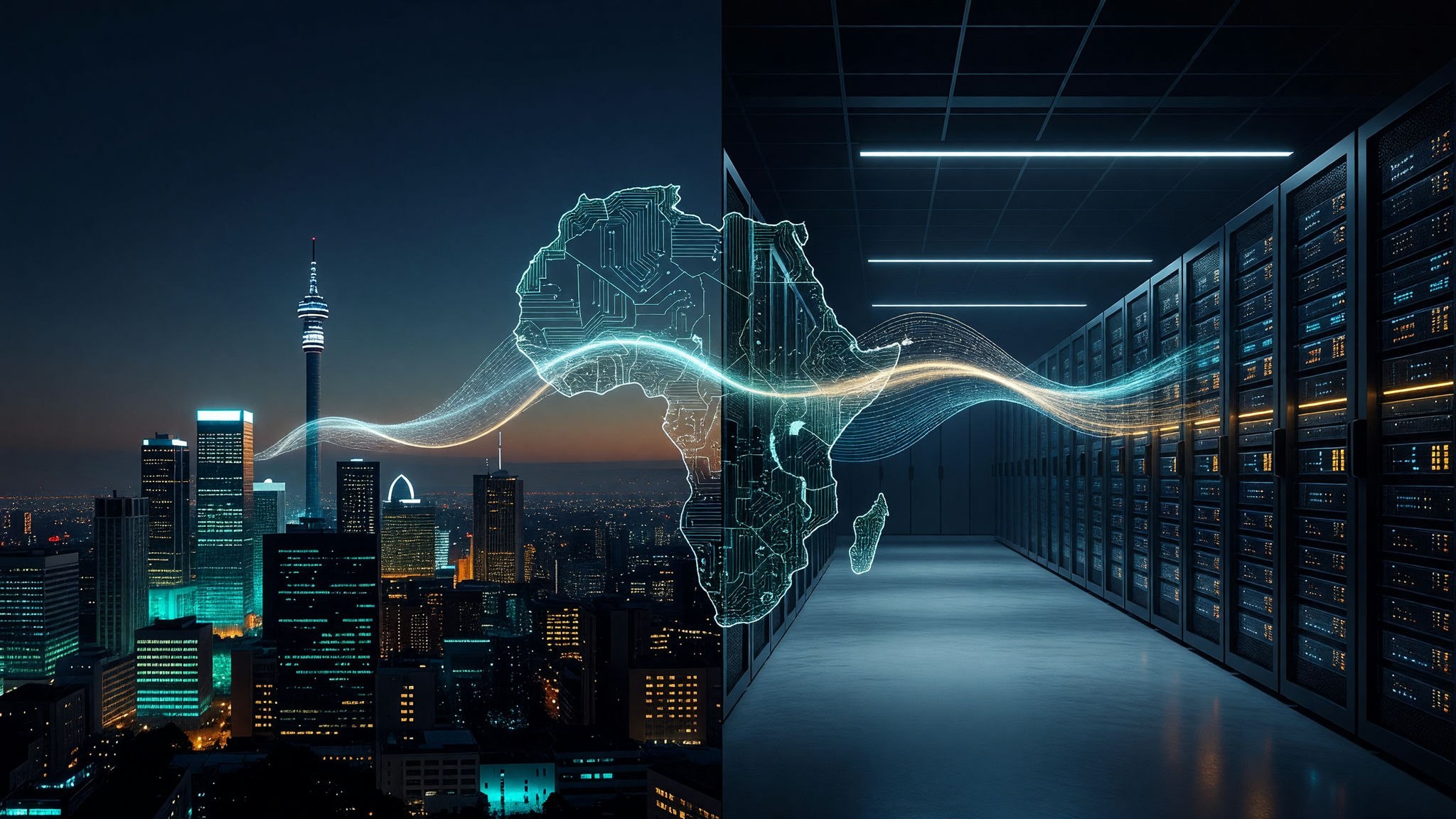
South Africa's AI Moment: Why We Must Stop Importing the Future and Start Building It
Cloud Prime Connect
Cloud Prime Connect
South Africa may be standing at the threshold of one of the greatest economic opportunities since the dawn of the industrial age. The question is whether we will seize it, or once again watch other nations build the industries of the future while we become their customers.
President Cyril Ramaphosa's working visit to Silicon Valley this week presents an important opportunity for South Africa. His engagements with global technology companies, investors, researchers and universities signal a recognition that artificial intelligence will play a defining role in the future of the global economy.
But attracting investment and taking photographs with technology executives cannot be the ultimate measure of success. The real measure will be what happens when the delegation returns home.
Will we build an economy that produces AI technologies, infrastructure and solutions? Or will we continue importing technologies developed elsewhere, paying foreign companies to solve problems that South Africans could increasingly solve themselves?
I believe South Africa has an extraordinary opportunity to choose the former.
An electricity opportunity hiding in plain sight
For years, South Africa's electricity crisis has been one of the greatest obstacles to economic growth. Businesses have struggled with uncertainty, factories have faced interruptions, and investors have questioned whether our energy infrastructure could support industrial expansion.
However, the situation is changing.
Eskom announced on 13 November 2026 that approximately 6,933MW of generation capacity was available above current demand requirements. Its improving generation performance presents an opportunity to support additional industrial demand and investment.
This is an important economic development.
Instead of looking at additional electricity capacity purely as an energy-sector achievement, we should begin asking how that capacity can be converted into productive economic activity.
AI data centres are among the infrastructure investments worth considering.
These facilities require substantial and dependable electricity to operate advanced computing equipment, cooling systems and associated infrastructure. They can create sustained demand for electricity while supporting an entirely new digital industrial ecosystem.
South Africa should actively position itself to attract international investment into AI-focused data centres, high-performance computing facilities and supporting digital infrastructure.
Imagine international technology companies investing billions of rand in facilities located on South African soil — employing South Africans, purchasing services from local suppliers, and developing infrastructure that supports both African and international markets.
Of course, additional generation capacity does not automatically mean every location has spare electricity, or that the transmission network can accommodate unlimited new demand. Grid capacity, water availability, environmental sustainability, electricity pricing and reliable supply agreements must all form part of the investment strategy.
But the opportunity is real, and it deserves serious consideration.
From electricity to an entirely new industrial economy
The economic value of AI infrastructure extends far beyond the construction of data centres.
A major AI infrastructure investment creates opportunities across multiple industries.
Construction companies, electrical engineers, mechanical engineers, cooling specialists, cybersecurity professionals, network engineers, software developers and technical maintenance teams all become part of the ecosystem. Universities and technical colleges gain opportunities to develop specialised training programmes. Local technology companies can build software, automation platforms, cybersecurity solutions and AI applications that run on this infrastructure. Small businesses can become suppliers, service providers and technology partners.
The multiplier effect could be significant.
South Africa has spent decades discussing unemployment, industrialisation and the need to attract foreign direct investment. AI infrastructure offers an opportunity to address several of these challenges through one strategic investment programme.
More importantly, we should not measure success only by the number of jobs created during construction. We should measure it by the number of permanent technical jobs, research opportunities, locally owned technology businesses and intellectual property developed in South Africa.
We must move from consuming AI to producing it
There is a fundamental difference between a country that uses artificial intelligence and a country that develops, owns and commercialises artificial intelligence solutions.
South Africa must aspire to become the latter.
At present, many businesses and institutions are adopting AI platforms developed in the United States, Europe and Asia. Adopting international technology is necessary — but it should not become our permanent economic position.
We should be building our own AI-powered platforms, training our own engineers, developing solutions for African markets and exporting those solutions to the rest of the world.
Our greatest advantage may not be competing with Silicon Valley to build the next global foundation model. It may be developing AI technologies that solve real problems in emerging markets.
South Africa understands the complexities of multilingual communication, healthcare administration, financial inclusion, public-sector inefficiency, agricultural development and service delivery.
These are not abstract technology problems. They are real economic opportunities.
With appropriate computing infrastructure, investment, research partnerships and skills development, South African companies could become global suppliers of specialised AI solutions.
AI could transform the way government works
Perhaps one of the most significant opportunities lies within our own government.
South Africa spends enormous amounts of money administering public services. Yet citizens continue to experience long queues, administrative delays, inefficient processes, communication difficulties and inconsistent service delivery.
AI could help change this.
Imagine public hospitals using intelligent systems to assist with appointment scheduling, patient administration, record management and resource planning.
Imagine government departments using AI to process applications, identify administrative bottlenecks, detect irregularities and respond to citizens more efficiently.
Imagine municipalities using predictive systems to identify infrastructure maintenance requirements before failures become expensive emergencies.
Imagine public procurement systems using AI-assisted analysis to flag suspicious pricing patterns, identify potential conflicts of interest and improve transparency.
AI will not automatically eliminate corruption or incompetent administration. Nor should sensitive decisions about people's rights, healthcare or public benefits be delegated to machines without proper human oversight.
However, properly implemented AI systems could give public institutions better information, improve accountability, and help government deliver more services with the resources it already has.
The objective should be a government that is more responsive, efficient, transparent and accountable.
The skills revolution must happen alongside the investment
There is little value in attracting international technology companies if South Africans remain spectators in the industry being developed on their own soil.
Every major AI infrastructure investment should have a corresponding skills-development programme.
We need more South African data scientists, AI engineers, machine-learning specialists, cloud architects, robotics engineers, cybersecurity professionals and software developers.
But we should also recognise that AI will create opportunities beyond traditional engineering qualifications. Business analysts, healthcare professionals, accountants, lawyers, educators, administrators and entrepreneurs will increasingly need the ability to work alongside intelligent systems.
Our universities, TVET colleges and private-sector training institutions should work together to ensure that the skills pipeline develops at the same pace as the infrastructure.
International investors should be encouraged to establish research partnerships, graduate programmes, technical academies and apprenticeship opportunities.
We should be exporting highly skilled South African talent because our people are developing technologies here — not because they have been forced to leave in search of opportunities elsewhere.
Is it time to rethink how we attract foreign investment?
We must also confront an uncomfortable reality.
South Africa competes internationally for capital, technology and infrastructure investment. Investors compare our regulatory environment, taxation, electricity costs, labour requirements, infrastructure readiness and the time it takes to establish operations.
Our transformation objectives remain important. Redressing historical economic exclusion and creating meaningful opportunities for previously disadvantaged South Africans must remain part of our national development agenda.
However, we must continuously examine whether the way we implement certain requirements is achieving the intended economic outcomes — or unintentionally discouraging investment that could expand the economy.
I am not advocating the abandonment of B-BBEE or the reversal of transformation. I am advocating a more strategic and investment-friendly approach.
Government should consider targeted incentives and appropriately designed regulatory arrangements for qualifying strategic AI infrastructure investments, particularly projects involving substantial capital expenditure, technology transfer, local skills development, research partnerships and export potential.
Special Economic Zones could provide a useful starting point.
We should explore streamlined approvals, predictable regulatory processes, competitive tax incentives, investment facilitation and appropriately structured transformation pathways for large international infrastructure investors.
Where international investors bring substantial capital, proprietary technology and specialised expertise, government should consider recognising meaningful local participation through skills development, supplier development, research collaboration, employee ownership and other measurable economic contributions — within the law.
The objective should be to attract investment while ensuring that South Africans participate meaningfully in the value created. We should not create a system in which attracting investment and achieving transformation are treated as mutually exclusive objectives.
We can pursue both.
What does this mean for South African technology companies?
For businesses like Cloud Prime Connect, the opportunity is particularly exciting.
We are already witnessing how AI can transform the way businesses communicate, operate and serve their customers.
At Cloud Prime Connect, our focus is on developing practical AI-powered business solutions: intelligent AI receptionists, automated customer communication, WhatsApp integrations, business chatbots and intelligent business automation.
These technologies allow businesses to automate routine interactions, respond to customers around the clock, improve operational efficiency and make better use of their human resources.
Consider what becomes possible when South Africa has greater access to locally developed AI infrastructure and computing resources.
We could develop more sophisticated AI agents for businesses, healthcare providers, financial institutions, municipalities and government departments.
We could build multilingual AI systems capable of communicating naturally in South Africa's official languages and other African languages.
We could develop locally relevant AI platforms that understand our markets, business environments and unique social challenges.
We could create intelligent systems that help small businesses compete with larger organisations, by giving them access to technology that was previously too expensive or complicated to implement.
We could build products in South Africa, employ South Africans, and export those products across the continent and internationally.
Cloud Prime Connect sees itself as part of this emerging ecosystem: not simply a consumer of AI services, but a South African technology company contributing to the development and application of intelligent business solutions.
The development of AI infrastructure would create opportunities for companies like ours to innovate faster, build more capable products and serve a much larger market.
And we are certainly not alone. Hundreds of South African technology entrepreneurs and start-ups could benefit from an environment that makes advanced computing more accessible.
South Africa must think beyond the next investment announcement
The President's Silicon Valley visit should be the beginning of a much bigger national conversation.
We need a coordinated national AI industrialisation strategy that brings together government, Eskom, private investors, universities, research institutions, local technology companies and international technology partners.
We should identify suitable locations for AI infrastructure investments, establish clear energy procurement arrangements, accelerate grid development, facilitate access to computing infrastructure and create practical pathways for international investors.
We should establish measurable targets for local employment, skills transfer, research investment, local procurement, technology development and export revenue.
We should also ensure that South Africa's data protection, cybersecurity and digital sovereignty requirements are addressed from the beginning.
Most importantly, we need a government that understands that AI is not simply another technology trend. It is an emerging foundation of global economic competitiveness.
The countries that build the infrastructure, develop the talent, own the intellectual property and create the applications will have a considerable advantage in the decades ahead.
South Africa has an opportunity to become a leading AI hub for Africa. We have universities, technical talent, an established telecommunications sector, a developing digital infrastructure industry, a sophisticated financial sector and an improving electricity generation position.
What we need now is the political will, regulatory certainty and investment strategy to bring these advantages together.
The world is investing heavily in artificial intelligence. South Africa should not be satisfied with purchasing the finished products.
We should be building the infrastructure that powers them, developing the technologies that make them useful, and creating the companies that take them to the world.
We have an opportunity to turn electricity into infrastructure, infrastructure into innovation, innovation into businesses, and businesses into jobs and economic growth.
Let us not return from Silicon Valley with nothing but lessons about what other countries are doing. Let us return with investment commitments, partnerships, infrastructure projects and a clear determination to build something of our own.
South Africa must not merely prepare for the AI revolution.
South Africa must become one of the countries building it.
Cloud Prime Connect (Pty) Ltd is a South African technology company focused on AI-powered business communication, intelligent automation and digital business solutions. Learn more at cloudprime.co.za.