The Sky War Nobody in South Africa Is Talking About
Tullius Rachie
Cloud Prime Connect
How SpaceX and Amazon are fighting the biggest battle in space — and why your mobile operator is praying you don't notice.
Two Empires, One Orbit
Right now, 340 to 630 kilometres above your head, two of the richest men on earth are fighting a war. Not with missiles. With satellites.
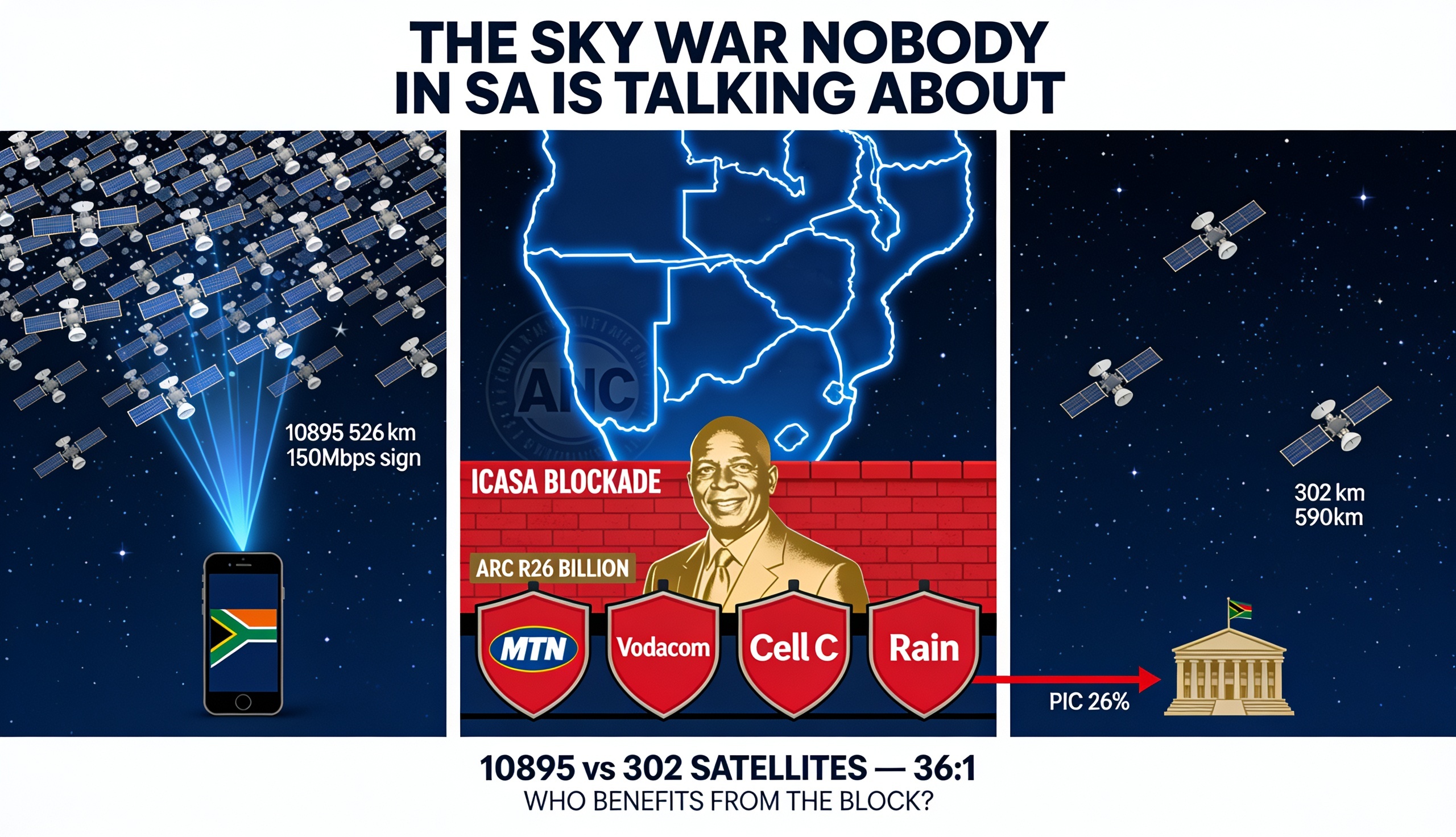
Elon Musk's SpaceX has 10,895 active Starlink satellites circling the planet — the largest private satellite constellation in human history. The service has 12 million paying subscribers across 160 countries and territories as of June 2026, and generated US$11.4 billion in revenue in 2025 alone. SpaceX is authorised to fly 12,000 satellites, has applied for 42,000, and is already planning a brand-new fleet of 15,000 Direct-to-Cell (DTC) satellites that will orbit so low they'll skim the edge of the atmosphere.
Jeff Bezos's Amazon Kuiper (marketed as "Amazon Leo") has 302 satellites in orbit. That's it. Three hundred and two. Authorised for 3,236 in its first generation, with a second generation approved in January 2026 bringing the total planned to 7,727. Its FCC deadline requires 50% of Gen1 — 1,618 satellites — in orbit by 30 July 2026. As of mid-2026, it has launched 18.7% of that target and is begging the regulator for an extension.
| Metric | Starlink | Amazon Kuiper | Ratio |
|---|---|---|---|
| Active satellites (mid-2026) | 10,895 | 302 | 36:1 |
| Total planned | 42,000 | 7,727 | 5.4:1 |
| Subscribers | 12 million | Pre-launch beta | — |
| Countries served | ~160 | 5 (beta) | — |
| Revenue (2025) | US$11.4 billion | $0 | — |
| Launch vehicles | Owns Falcon 9 + Starship | Rides on others' rockets | — |
Amazon is buying seats on ULA's Atlas V, Arianespace's Ariane 6, and even on SpaceX's own Falcon 9. The competitor it's trying to beat is also its most important taxi.
This is not a race. This is a man who owns the road, the car, and the fuel station, racing a man who is hailing a cab.
And while the two giants fight for the sky, a third player lurks: Eutelsat OneWeb — the only other operational global LEO constellation, with ~600 satellites. The French group reported €1.24 billion in 2025/2026 revenue. But OneWeb is a B2B play selling capacity to governments and enterprises, not a consumer broadband service. For ordinary phone users in Africa, the real fight is between Starlink and the mobile operators who fear what's coming.
Why Direct-to-Cell Changes Everything
Until now, satellite internet meant a dish on your roof. Direct-to-Cell (DTC) is the next leap — and it's the one that has every mobile operator on the planet terrified.
DTC means a satellite talks directly to your existing smartphone. No dish. No terminal. No special hardware. The phone in your pocket connects to a satellite the same way it connects to a cell tower — except the tower is 340 kilometres above you, moving at 27,000 km/h.
Today, Starlink's DTC service delivers about 4 Mbps per user. In February 2026, at the ITU Space Connect conference, SpaceX announced its next move: 150 Mbps per user — on the same spectrum it already owns (AWS-4 and H-Block, bought from EchoStar in a $17 billion deal).
How do you get 37.5x more speed from the same spectrum? You go lower. SpaceX has filed with the FCC to deploy 15,000 new satellites into Very Low Earth Orbit (VLEO) — altitudes between 326 and 335 kilometres. That's 255 km closer than Kuiper's lowest shell.
Each satellite carries a 2,400-square-foot phased array antenna — a flying cell tower the size of a billboard. Sequoia Capital calls DTC the "fourth wave" of SpaceX growth, projecting a $17.8 billion global mobile-satellite market by 2028.
This is the part where mobile operators reach for the antacids.
Why South Africa Said No
Starlink is illegal in South Africa. ICASA requires 30% black ownership under B-BBEE. SpaceX won't cede equity.
But the receipts tell a different story:
- SpaceX accepted BEE — Ryan Goodnight's submission: "SpaceX supports (and does not seek any amendments to) the South Africa requirement or the BBBEE requirement."
- SpaceX proposed a R2.5 billion EEIP — land leasing, fibre, energy, maintenance partnerships
- SpaceX endorsed Minister Malatsi's December 2025 policy direction — formally, in writing
- SpaceX pledged R500 million for 5,000 rural schools — 1.2 million children
- SpaceX published its position publicly — PDF on starlink.com, advocacy campaign Feb 2026
ICASA rejected the EEIP route. ICASA chair Mothibi Ramusi: "non-negotiable unless Parliament amends the law."
The ANC propaganda line — and why it collapses
"Musk refused BEE" → He accepted it, proposed an EEIP, endorsed the policy, pledged R500m. "Refused" appears nowhere in the record.
"He wants special treatment" → Microsoft, Google, Cisco, Amazon, IBM all use EEIPs. SpaceX wants the same treatment.
"30% is non-negotiable" → The word "non-negotiable" isn't in the B-BBEE Act. It's ICASA's interpretation — which the Department of Communications contradicts.
"It's about empowerment" → It blocks the service that benefits black South Africans most — rural schools, township businesses, clinics.
"Just comply like everyone else" → Starlink is complying via EEIP. ICASA is refusing to accept the compliance.
Meanwhile, 14,000 South Africans use Starlink illegally through roaming. ICASA seizes equipment. SA is the only major African market where Starlink is blocked — licensed across most of the continent.
Follow the Money: Who Loses If Starlink DTC Lands in SA?
Motsepe, Rain, and the ANC Connection
- Patrice Motsepe — net worth $3.7B (Forbes June 2026)
- Sister Tshepo Motsepe married to President Cyril Ramaphosa (Source: Wikipedia)
- Sister Bridgette Radebe married to Jeff Radebe, ANC cabinet minister (Source: Wikipedia)
- ARC holds 21% of Rain — South Africa's first 5G operator
| Date | ARC Stake | ARC Value | Rain Valuation |
|---|---|---|---|
| Dec 2017 | 20.0% | R1.89B | R9.46B |
| June 2021 | 20.26% | R3.31B | R16.36B |
| June 2023 | 20.25% | R4.52B | R22.3B |
| June 2024 | 21.0% | R5.24B | R24.95B |
Source: MyBroadband, ARC annual results
Rain dies if DTC lands. 700 5G sites become stranded. R5.24B investment written down. The President's brother-in-law takes a multibillion-rand hit.
The PIC Connection — Government Owns MTN
- PIC = state-owned entity, R2.693 trillion AUM (Source: Wikipedia)
- Manages the Government Employees Pension Fund
- Holds ~26% of MTN Group
The chain: ICASA blocks Starlink → ICASA appointed by Minister → Minister serves in government whose pension fund owns 26% of MTN → President's brother-in-law owns 21% of Rain → MTN, Vodacom, Cell C, Rain all lose billions.
This is structural incentive alignment. When every decision-maker's financial interests point the same direction, you don't need a smoke-filled room. The outcome is baked in.
The Human Cost of the Blockade
18 million South Africans disconnected. SA ranks 52nd globally for mobile internet affordability.
Every month blocked: R500 million school connectivity delayed. R2.5 billion infrastructure investment delayed. 1.2 million children denied digital education. Clinics without telemedicine. Farmers without market data. Township businesses paying 5-10x more for data.
The 14,000 who access Starlink illegally are the ones who can afford it — urban professionals, farmers with means. The people who can't access it are the rural poor — exactly the people BEE was designed to help. The blockade doesn't hurt Elon Musk. It hurts the people the policy claims to protect.
Protectionism dressed in empowerment clothing.
What Happens If DTC Lands
- Every smartphone becomes a broadband terminal — no dish, no SIM swap
- Mobile operators become dumb pipes or die
- Rural connectivity solved overnight
- Data prices collapse — real competition for the first time
- R2.5B invested locally, 5,000 schools online, thousands of jobs created
- 18 million unconnected become a market, not a charity case
The Real Question
Not whether Musk "refused BEE" — he didn't. Not whether 30% ownership is good policy — it is, where achievable. Not whether foreign companies should comply — they should, and SpaceX is.
The question: who benefits from the block?
The people paying the price aren't the people whose R25.9 billion valuations are being protected. The people protected are: the President's brother-in-law (Rain / ARC), the government's own pension fund (MTN / PIC), and two multinationals who profit from South Africans having no alternative (Vodacom / Cell C).
This is not empowerment. This is incumbent protection — done in the name of the very people it harms.
The Bottom Line
SpaceX: 10,895 satellites, 12 million subscribers, $11.4B revenue, 160 countries. South Africa: zero of that — because a regulator won't open a door the country's own B-BBEE Act provides.
The satellites are ready. The spectrum is bought. The EEIP is proposed. The R500m is pledged. The law provides the mechanism. The Minister endorsed the policy.
The only thing standing between you and 150 Mbps from the sky is a piece of paper in ICASA's filing cabinet — and the people whose valuations that paper protects.
Open the door. Or explain to 18 million South Africans why they must stay offline so billionaires and pension funds can stay comfortable.
The sky war is not coming. It's here. The only question is whose side the South African government is on — the people's, or the balance sheets.
Tullius Rachie is the digital operations lead at Cloud Prime Connect, a Johannesburg-based telecoms and ICT services provider. This article reflects personal analysis and does not represent an official position of Cloud Prime Connect.
Sources: OrbitalRadar, SatNews, ISPreview, Teslarati, TechCentral, SpaceX SEC Form S-1, Wikipedia (Starlink, Patrice Motsepe, PIC), MyBroadband, TechFinancials, Africa Business Insider, ICASA, ARC Annual Results, Sequoia Capital, FCC filings.